What Jikiden Reiki is
Reiki is a Japanese practice developed in the early twentieth century by Mikao Usui. It’s offered in many forms today, and the one I practise is Jikiden Reiki – which translates roughly as “directly taught” – the traditional Japanese lineage passed down through Chiyoko Yamaguchi and her family.
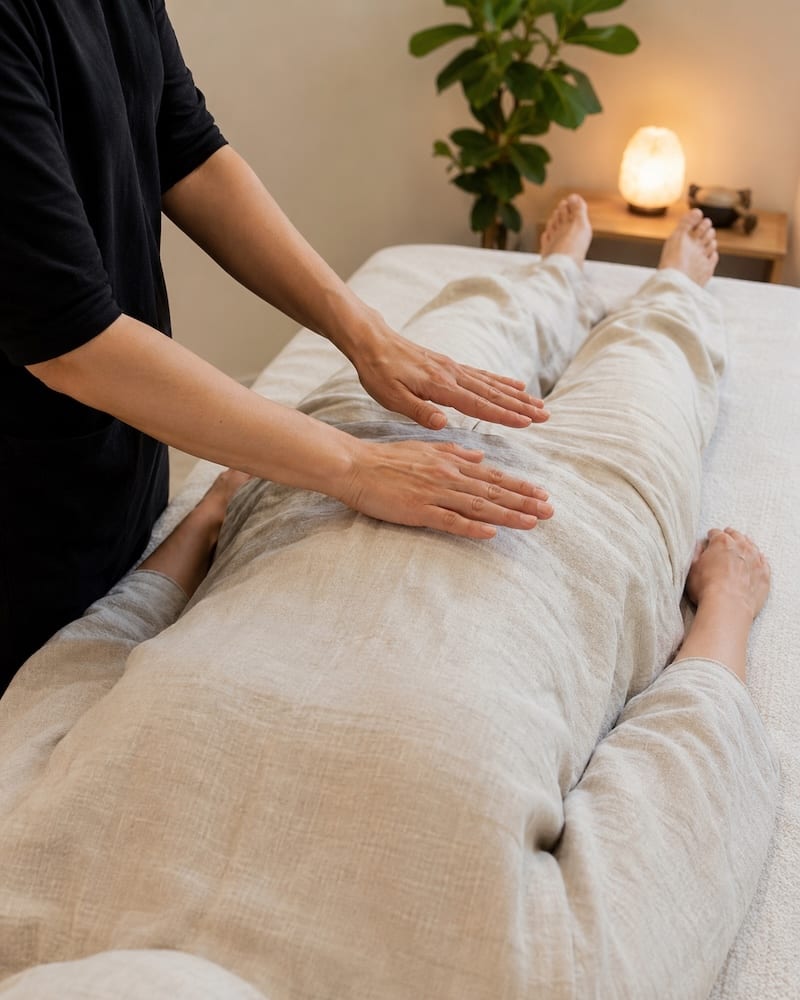
The difference matters. Jikiden Reiki keeps the practice close to its original form: simple, practical, and focused. There’s no ceremony, no symbols added later in the West, no esoteric overlay. Just a quiet hour where I place my hands lightly on or above different areas of your body, and you rest.
Many clients describe the experience as like a long, held pause. Some fall asleep. Some feel warmth or tingling. Others feel nothing in particular and simply notice afterwards that they feel calmer or more rested than when they arrived. There’s no “right” experience.
I should be clear: I don’t make claims about what Reiki does. What I can tell you is that clients find it quietly restorative, and many return regularly for that reason.
What happens in a session
When you arrive, we’ll sit down briefly to talk about how you’re feeling and whether there’s anything you’d like me to pay attention to. You stay fully clothed throughout – most people choose comfortable, loose-fitting clothes.
You’ll lie on the treatment couch, on your back, covered with a blanket if you’d like one. I’ll work through a sequence of hand positions, some with gentle contact and some with my hands held just above your body. You don’t need to do anything, think about anything, or try to feel anything in particular. Most clients simply rest.
A session lasts 60 minutes. Your first appointment includes an extra 30 minutes at the start, to allow time for the initial conversation.
Who it appeals to
Clients often come to Jikiden Reiki when they need:
- An hour of genuine rest and stillness
- Support through a stressful or unsettled period
- A gentle session when other therapies feel like too much
- Something quiet to settle the mind
- A complement to other forms of self-care
Reiki is not a medical treatment, and I won’t suggest it as a replacement for one. If you have a specific health concern, please speak to your GP.
Is it religious?
No. Reiki originated in Japan in a cultural context that included Buddhist and Shinto ideas, but it isn’t a religion and it isn’t a belief system. You don’t need to believe in anything for the session to work as a form of rest. Many of my Reiki clients would describe themselves as sceptical, pragmatic, or simply curious – that’s absolutely fine.
Distance Reiki
I also offer distance Reiki sessions for clients who can’t travel. These are arranged in advance and we speak by phone or video either side of the session. Please mention distance Reiki specifically when you get in touch if that’s what you’re looking for.
Session length and price
| Session | Duration | Price |
|---|---|---|
| Session | 60 minutes | £40 |
| Children (2-12 years) | 30 minutes | £20 |
| Distance Reiki | 60 minutes | £40 |
| Loyalty card – book 6, get the 6th free | — | — |
See the full prices page.
My training in Jikiden Reiki
I trained in Jikiden Reiki with Debbie Cook, an experienced Jikiden Reiki Shihan whose training meets the standards of the Jikiden Reiki Kenkyukai in Japan. I hold Shoden (Level 1) and Okuden (Level 2).
I completed my training in 2018 and have attended Debbie’s monthly practice workshops every month since – this matters in Reiki, where ongoing practice is considered essential rather than optional.
I’m a member of the Jikiden Reiki UK Association, a full member of the Association of Reflexologists (MAR), and a member of the Federation of Holistic Therapists (FHT). Read more on the about page.
Frequently asked questions
What’s the difference between Jikiden Reiki and regular Reiki?
Most Reiki taught in the West is Western-style Reiki, which developed after the practice moved to Hawaii and the United States in the twentieth century. Jikiden Reiki is the older Japanese form, preserved in its original structure. In practice, the session feels similar from a client’s perspective. The main difference is in how the practitioner has been trained.
Do I need to undress?
No. You stay fully clothed throughout. Comfortable, loose clothing works well.
What will I feel during the session?
Some people feel warmth, a sense of heaviness, tingling, or quiet emotional release. Others feel nothing at all during the session and simply notice afterwards that they feel rested. All of these are common. There’s no particular experience you’re supposed to have.
Is Reiki a religion?
No. It’s not a religion or a belief system, and you don’t need to believe in anything for the session to be restful.
How many sessions should I have?
There’s no fixed answer. Some clients come occasionally when they need it. Others settle into a regular weekly or monthly rhythm. We can talk about what feels right after your first visit.
I have been coming to Gemma for many years now as I have never found such a good therapist in so many ways. She is conscientious and reliable and so passionate about Reflexology and the other treatments like Indian Head Massage and Reiki. She is totally 100% in to it every time.
Charlotte, Kingsworthy